



No products in the cart.

HEC Fehm-e-Quran I • University Course Books
Course Books for Understanding of Quran I / Fehm-e-Quran
A structured university course that begins with familiar Qur’anic words and gradually opens the way to phrases, sentences and verses — helping students understand more of the words of Allah as they recite.
“And We have certainly made the Qur’an easy for remembrance, so is there anyone who will be mindful?” — Surah Al-Qamar 54:17
HEC
Muallim ul Quran Volumes 1, 2 & 3 are listed as the course books for Understanding of Quran I / Fehm-e-Quran I.
₨1,500 ₨1,125 25% OFF
FREE DELIVERY
Transfer to MQ Meezan Bank Account and send screenshot on WhatsApp +92 300 546 1717. Order dispatch follows payment confirmation.
Your university campaign journey goes beyond the book
Online coordinator guidance
Learning & assessment journey
One-night experience
One brick in your name
Understanding of Quran I
Course books listed in the model outline
Structured semester learning
45–48 contact hours
The Purpose Behind the Course
A university course can carry credit hours, but the deeper purpose is far greater: to help a Muslim begin understanding the words of Allah while reading and listening to the Qur’an.
For many Muslims, the Qur’an is recited with love, yet its Arabic is still not understood directly. Fehm-e-Quran I is designed to begin changing that.
Through Muallim ul Quran Volumes 1–3, students gradually learn to recognize Qur’anic vocabulary, understand phrases and sentence structures, and build the foundation needed to follow the meaning of longer verses.
The aim is not simply to study Arabic as another university subject. It is to make the language of the Qur’an increasingly familiar — so that more of its message becomes meaningful during recitation, salah, listening and reflection.
Muallim ul Quran • Fehm-e-Quran learning philosophy
Course at a Glance
A concise academic view of the first university course and its learning material.
HEC Course |
Understanding of Quran I / Fehm-e-Quran I |
Course Books |
Muallim ul Quran — Vol. 1, 2 & 3 |
Author |
Dr. Ubaid ur Rahman Bashir |
Credit Structure |
1 (0–1) credit hour in the HEC model outline |
Contact Hours |
3 hours per week |
Duration |
15–16 weeks / approximately 45–48 contact hours |
Learning Flow |
Qur’anic Words → Phrases → Sentences → Verses → Introduction to Present-Tense Verbs |
Inside the Syllabus
The course moves gradually from familiar Qur’anic words toward meaningful phrases, complete sentences and verses.
1
Students begin with frequently occurring Qur’anic words and foundational patterns including nouns, masculine/feminine forms, plurals, demonstratives, particles and prepositions.
2
Learners begin understanding combinations that appear repeatedly in the Qur’an, including adjective and possessive constructions.
3
Pronouns, prepositions, sentence structures and recurring Qur’anic expressions allow the learner to understand increasingly complete meanings.
4
Students move toward understanding Qur’anic verses and are introduced to present-tense verbs and verbal sentences.
Word by word. Phrase by phrase. The distance between recitation and understanding begins to decrease.
HEC Model Course Outcome
The model outline sets an important first-course benchmark while keeping the wider journey of Qur’an understanding open-ended.
HEC’s model outline states that students should be able to understand approximately 30–40% of each page of the Holy Qur’an after completing Understanding of Quran I.
✓ Understand basic Qur’anic words, phrases and sentence structures.
✓ Build a foundation for understanding longer Qur’anic verses with greater clarity.
✓ Recognize important vocabulary, particles, compounds, pronouns and plural forms.
✓ Understand different styles of Qur’anic sentences and expressions.
✓ Begin recognizing the language of the Qur’an independently during recitation and listening.
The Muallim ul Quran Approach
Students meet the language of the Qur’an first — not a wall of technical grammar terminology.
Muallim ul Quran begins with the words and structures students actually encounter in the Qur’an. As patterns recur, recognition grows naturally.
The goal is not vocabulary memorization in isolation, but the ability to see how Qur’anic words connect and carry meaning together.
See the word.
Recognize the pattern.
Understand the phrase.
Read the sentence.
Connect it with the verse.
Every lesson adds something the learner can recognize again when opening the Qur’an.
For Faculty & Universities
The HEC model outline recognizes a supporting learning ecosystem for effective course delivery.
📚
Muallim ul Quran Vol. 1–3 for Fehm-e-Quran I.
▶
Lesson-by-lesson tutorial support for students and teachers.
✓
Students can check and confirm their understanding lesson by lesson.
📝
Quizzes, question papers, images and other helping material.
HEC / NAHE Implementation
The Fehm-e-Quran initiative was introduced for implementation in universities, with academic support, faculty training and ongoing monitoring mechanisms.
In March 2025, HEC directed recognized universities and degree-awarding institutions to incorporate Understanding of Holy Quran / Fehm-e-Quran courses for Muslim students, with rollout from Fall 2025.
For Fehm-e-Quran I, the model course outline identifies Muallim ul Quran Volumes 1, 2 and 3 as the course books and provides a detailed semester plan for words, phrases, sentences and verses.
HEC/NAHE later established implementation support and faculty-training structures to help universities deliver the course effectively.
HEC course incorporation notification issued.
Implementation consultant role formally notified.
Implementation clarifications shared with universities.
Fehm-ul-Quran Section established within NAHE for faculty capacity building.
Author & Academic Support
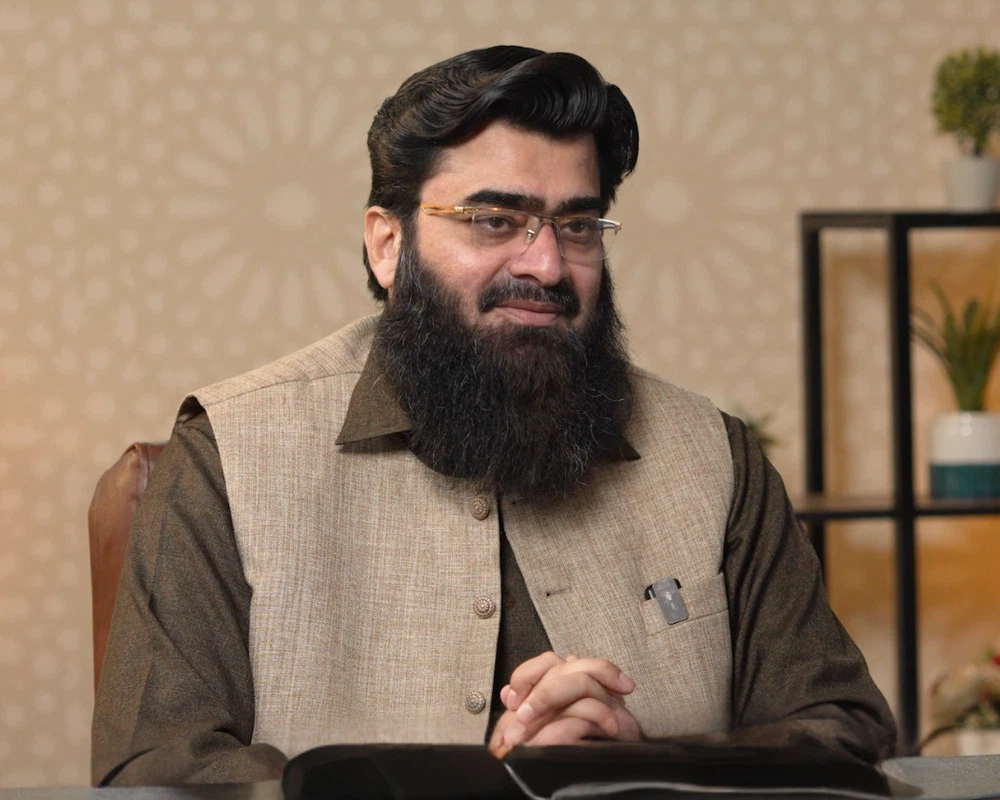
Consultant, Fehm-e-Quran
HEC records assign Dr. Ubaid ur Rahman Bashir an implementation-support role for the Fehm-e-Quran initiative, including curriculum guidance, faculty training, assessment and delivery models, coordination with universities, monitoring and evaluation, and academic resource development.
The same academic philosophy is reflected in Muallim ul Quran: begin with the Qur’an itself, make its language familiar, and help the learner move toward direct understanding with confidence.
MQ University Campaign
These are Muallim ul Quran campaign benefits for eligible university participants and are separate from the HEC course requirements.
💬
A coordinator can guide students as they work through the Muallim ul Quran learning sequence.
🏅
An opportunity to complete the wider Muallim ul Quran learning journey with assessment and recognition.
🌙
An opportunity to spend time in a learning environment connected with Qur’an, Masjid and service.
🧱
One brick is contributed to Rehmat Village in the participant’s name — linking learning with an act of ongoing benefit.
Use authentic university, classroom and student-learning videos here rather than generic commercial testimonials.
Muallim ul Quran Vol. 1 + 2 + 3 for Fehm-e-Quran I — with free delivery.
FREE DELIVERY
FAQs
This set contains Muallim ul Quran Volumes 1, 2 and 3, which are listed as the course books for Understanding of Quran I / Fehm-e-Quran I in HEC’s model course outline.
The course is known as Understanding of Holy Quran I / Fehm-e-Quran I.
HEC’s model course outline specifies 15–16 weeks, approximately 45–48 contact hours, with 3 contact hours per week.
Students progress from Qur’anic vocabulary and phrases to compounds, pronouns, sentence structures, verses and an introduction to present-tense verbs.
HEC’s model course outline states an expected outcome of approximately 30–40% understanding of each page of the Holy Qur’an after completing Understanding of Quran I.
Yes. Supporting material includes printed books, tutorial videos, confirmation videos, flipbook access, quizzes, question papers and other teacher resources.
Yes. The MQ university campaign is intended for eligible university students and professors, with verification handled during checkout.

Making Quranic Arabic easy and accessible for every Muslim — through the revolutionary QLB methodology by Dr. Ubaid ur Rehman Bashir.